OCTAV8 ACADEMY
The problem was never your mix. It was never your plugins. It was the canyon between bar 8 and the final bounce. Nothing you’ve tried has given you a way across.
Get the Guide · $3330 years behind the DAW · Distributed through the #1 pro DJ and radio service
One guide. One framework. One loop in, one finished song out.
As Featured In
Revolution808You know the loop. You built it on a Tuesday, headphones on, and for those first eight bars everything locked. The kick sat right. The melody landed. The bass had weight. You played it back on repeat and thought: this one is different.
Then you tried to take it somewhere. You duplicated it out to 16 bars. Copied again to 32. Maybe you added a filter sweep. Stripped the drums for four bars and brought them back. And somewhere in that process the energy bled out. The thing that felt alive at eight bars felt flat at sixty-four. So you started second-guessing the sounds. Opened the mixer. Swapped a hi-hat. Told yourself the mix was the problem. It wasn’t the mix.
The folder on your hard drive has 47 projects in it. Maybe 200. Each one started with genuine excitement: something real, something that hit. Each one stalled somewhere between bar eight and the final bounce. You saved the project, opened a new one, and chased the next spark. And over time, a folder that deep with nothing shipped stops feeling like a music problem and starts feeling like a verdict.
You’ve heard the advice. “You just gotta push through, man.” Or: “Take a break bro. You might be burned out.” Or the one that sounds wise until you actually think about it: “Art is never finished, you just gotta let it go.” None of that helped. Because none of it addressed the actual problem.
You’re not lazy. You’re not lacking talent. You’re not burned out. If you were, you wouldn’t keep opening new projects. The discipline was never missing. You had enough discipline to learn your DAW, enough motivation to build a hundred loops that knock. Something else is missing.
The problem was never talent or willpower. Every loop in that folder is proof you have the ear: the instinct that made something lock at bar 8 was real every single time. What was missing was never the spark. It was the map from the spark to the finish. You didn’t have a finishing problem. You had a completeness problem. And everything you’ve tried since has been solving the wrong thing.
Not sure yet? Start here.
The Finish Test — five checkpoints to know if your track is actually done. Free PDF.
Get the Finish Test · FreeThere is a map. The exact framework for taking what you feel in those first eight bars and carrying it all the way through arrangement, mix, and master to a release-ready song. You open a project and you know what to do next, not because someone gave you steps, but because you can see where the song needs to go.
One loop in. One finished song out.
The Finish Blueprint is a method. It gives you five concrete checkpoints that answer the real question: what a finished song actually needs to have. Not “done enough.” Not “just let it go.” Actually done: structurally complete, with nothing missing and nothing left to guess. The spinning stops. The path forward is clear.
It works with any DAW. Any genre. Trap, house, lo-fi, pop, ambient, drum and bass. The sounds and the tempo change. The structure underneath (what makes a song land) doesn’t. The method is grounded in published music cognition research (26 cited studies on how listeners hear melody, feel anticipation, and respond to structure), translated into production decisions you can make in your DAW today.
The guide stays open beside the DAW. Forward motion feels different once there’s an actual direction.
Every resource you’ve tried teaches technique: how to EQ a kick, how to sidechain, how to use a compressor. Technique matters, but technique is not why your tracks don’t land. You’ve been asking what you should do next, when the real question is what you’re feeling. The loop is already playing, hands off the mouse, eyes off the screen. What shows up isn’t a thought. It’s in the chest. The gut. The urge to move. That response is the most accurate instrument you own. Your job isn’t to be impressive. Your job is to be a mirror for what the listener gets to feel.
If YOU feel it, THEY’LL feel it.
You’re not someone who can’t finish. You’re someone whose most essential instrument, the ability to feel what the music is doing, was never activated. There are two skills that make finishing possible, and every course and tutorial skips both of them. Hearing: the practice of playing your track with hands off and noticing where your attention goes versus where it can go. That gap is the next arrangement decision. And feeling: trusting what your body tells you about whether the music is working. Chills, the urge to move, boredom at bar 17. These aren’t random. They’re your nervous system telling you what the song needs. The guide teaches you to read that instrument and use it.
Finishing gives you something no technique tutorial can — the moment you bounce the master, put it on your phone, and the song sounds like what you felt when you built that first loop. That feeling is not relief. It is recognition.
I build frameworks for a living, to help people get unstuck — I know what holds up under pressure and what collapses when you lean on it. The way Korrigon teaches isn’t adding a new system on top of your work. It’s unlocking what’s already there so the thing that was stuck starts moving. It reorganized how I think about getting from an idea to something finished, and that applies whether the output is a business, a creative project, or your next song.Cameron — framework builder, long-term client
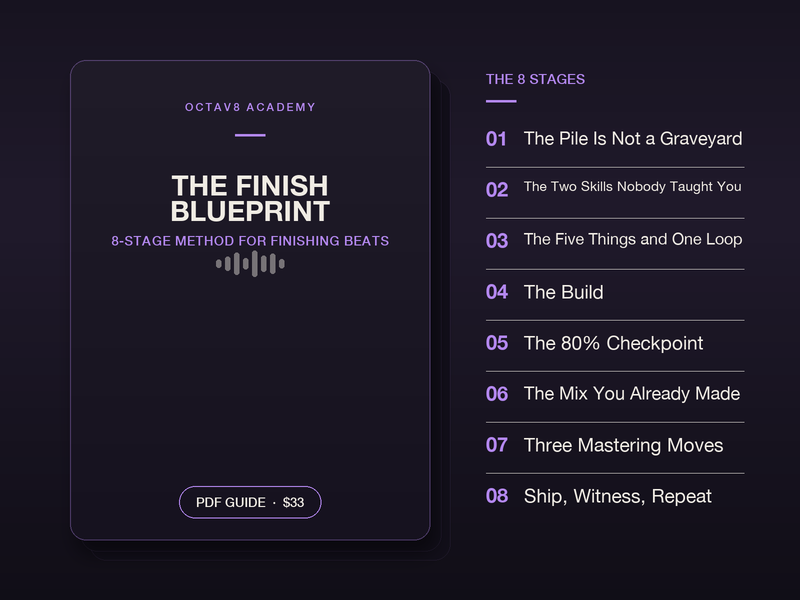
Five checkpoints that replace guessing with knowing. The Feeling, The Shape, The Stamp, The Face, The Room, then one final pass back to The Feeling. If the answer to all five is yes, the song is done. You’ll know.
These five checkpoints are available as a free cheat sheet. Get the Finish Test · Free
Hearing and feeling, trained as one practice on your own open project: playing, noticing, moving. Every exercise runs on the track you’re building, not a hypothetical. By the end, you’re not following a checklist or asking anyone’s opinion; you’re reading your own music and knowing what it needs.
The shape of the entire track becomes visible before you lay a note. Your song’s emotional arc, sketched before you build a single new section: where the energy rises, where it peaks, where it drops to the floor. The feeling gets drawn first, and the arrangement fills itself in.
The structural stop that prevents the spiral. When your arrangement feels roughly 80% done, bounce stems and close the original project. No new parts. No new sounds. The palette is closed. You work with what the song already gave you.
Finishing is a body problem, not a knowledge problem. The guide names fourteen patterns that fire at specific stages of production (freeze, shame spiral, novelty trap, over-identification, completion anxiety, impostor syndrome, and more) so you can see them coming, and gives you a structural move through each one.
The three essential steps from finished arrangement to release-ready: reduce what you don’t want, enhance what you do, make it louder. What to do, in what order, when to stop. No rabbit hole — just enough to ship with confidence.
Beat Action Sheet. Track Card Template. Stage Reference Card. Built to print and live at the desk, written on during sessions. Two color schemes: dark for the studio, light for daylight.
This is built for you if:
This isn’t the right guide if:
If the first list sounds like your folder, the guide is below.

Korrigon has been producing for 30 years. His edits and remixes are distributed through Promo Only, the #1 professional DJ and radio distribution service, reaching Armed Forces Network, Disney, iHeart, and Sirius/XM. Tracks he released over twenty years ago still get played. He sits in the same chair you do, staring at the same DAW. He built this method from the process that produced that work.
This is the same framework taught in The Finish Room, a live 8-week program where eight producers finish a release with trained ears on every session. The guide extracts the complete method into a self-guided format. Nothing is abridged.
I kept starting over thinking the next loop would be the one. This showed me the loop was never the problem.Producer — 6 years in the DAW
It’s more than just a how-to. The Finish Blueprint doesn’t just give you the technical stuff; Korrigon uses his own personal experience and learnings to explore the psychology behind why you’re not getting over the line and what you can do to get through that. Deep.Lee Stacey, Revolution808
Launch price — through November 30
$33
The complete method for going from “I don’t know what’s wrong” to “this is done.” Every framework, every exercise, every checkpoint. Instant download. Any DAW, any genre. Less than the cost of your last plugin.
Get the Guide · $33Not ready for the full method? Start with the free cheat sheet. The Finish Test · Free PDF
The method is structural, not stylistic. The five checkpoints apply whether you make trap, house, lo-fi, pop, ambient, drum and bass, or anything in between. The sounds change. What makes a song land does not.
Probably, yes. If your problem is finishing, not mixing, this guide addresses the gap that mixing tutorials skip entirely: how to get from an 8-bar loop to a complete arrangement worth mixing in the first place. The mixing and mastering sections are concise and opinionated, not exhaustive.
Most courses teach technique: how to EQ, how to compress, how to sidechain. This guide teaches finishing: how to know what the song needs next, how to feel when it’s done, and how to stop the loop of opening new projects instead of completing the one in front of you. It is a method, not a syllabus.
PDF. Instant download after purchase. Includes printable action sheets designed for your studio desk. Works on any device.
Neither. It is a PDF. You buy it once, download it, and it is yours. No login, no drip schedule, no recurring charge. If you want something more interactive, The Finish Room is the live group program: eight producers, eight weeks, one finished release each, with direct feedback from a working producer. A self-paced course, The Finish Lab, is available for pre-order.
The complete method. One framework. Instant download.
$33 · Get the GuideInstant download. Yours forever.
The guide gives you the map. The Finish Room gives you the guide applied to your track, live, for eight weeks, with trained ears on your arrangement, your mix, your master, in real time.
The map gets you there. The room makes sure you don’t walk it alone.